How to Teach Frankenstein So Students Argue Instead of Summarize
I'll be honest about how I used to teach Frankenstein: like something to survive. We'd march through the chapters, chip away at the archaic language, quiz the plot points, and somewhere around Walton's last letter, I'd look up and realize half my students had checked out weeks ago. We'd "finished the book." I'm not sure we ever actually read it.
Here's what I eventually figured out. Frankenstein doesn't lose students because it's hard. It loses them because we teach it as a plot to get through instead of an argument to have.
Stop teaching the plot. Teach the question.
Frankenstein was never really about what happens (a scientist builds a creature, the creature gets loose, everyone suffers). Told as a sequence of events, it's a slog. But sitting underneath those events is a question your students will actually fight about: are monsters born or made?
That question is the reason to read the book.
Victor assembles a living being and abandons it the moment it opens its eyes. The creature, cast out and unloved, slowly becomes the very thing everyone already assumed he was. So who made the monster here: the creature, or the man who walked away from what he made? Once that's the thing on the table, the archaic language stops being an obstacle and starts being evidence.
Why this novel is built for inquiry
Some books you have to pry a good question out of. Frankenstein hands you three before you've finished Volume I:
Is the real monster the creature, or his creator? Victor abandons what he makes, then spends the rest of the novel blaming it for what it became.
Does being cast out create a monster? The creature is gentle — curious, even tender — right up until the world is cruel to him, again and again and again.
Is it nature, or is it everything that happened after? He's born into nothing and shaped entirely by rejection. So which one are we actually looking at?
You don't have to manufacture engagement with questions like these. Actually? You really just have to get out of their way!
(One honest heads-up if you bring in the Medusa comparison below: her myth involves sexual assault. It's teachable and worth teaching with older students, but preview it for your particular room.)
The texts that bring the argument to life
A novel on its own can only ever give students one version of the monster: Shelley's. The conversation gets interesting the moment you set a second monster beside the creature and let the two of them argue with each other.
Put Medusa next to Victor's creation, and the question quietly changes from is this thing evil? to who decided it was? Put the Phantom of the Opera beside it — a boy caged for his face who grows up and cages himself — and students have to wrestle with how much of a monster is made by rejection and how much is chosen. Put the scientists of Jurassic Park in the room, and suddenly the conversation isn't about the creature at all; it's about the people who build something they can't control and then act surprised when it gets out. (That one sits next to Victor so perfectly it almost feels unfair 🤩.)
These aren't side dishes. A second text is what turns a reading of Frankenstein into an argument about it — and it hands your quieter students something solid to stand on when it's their turn to talk.
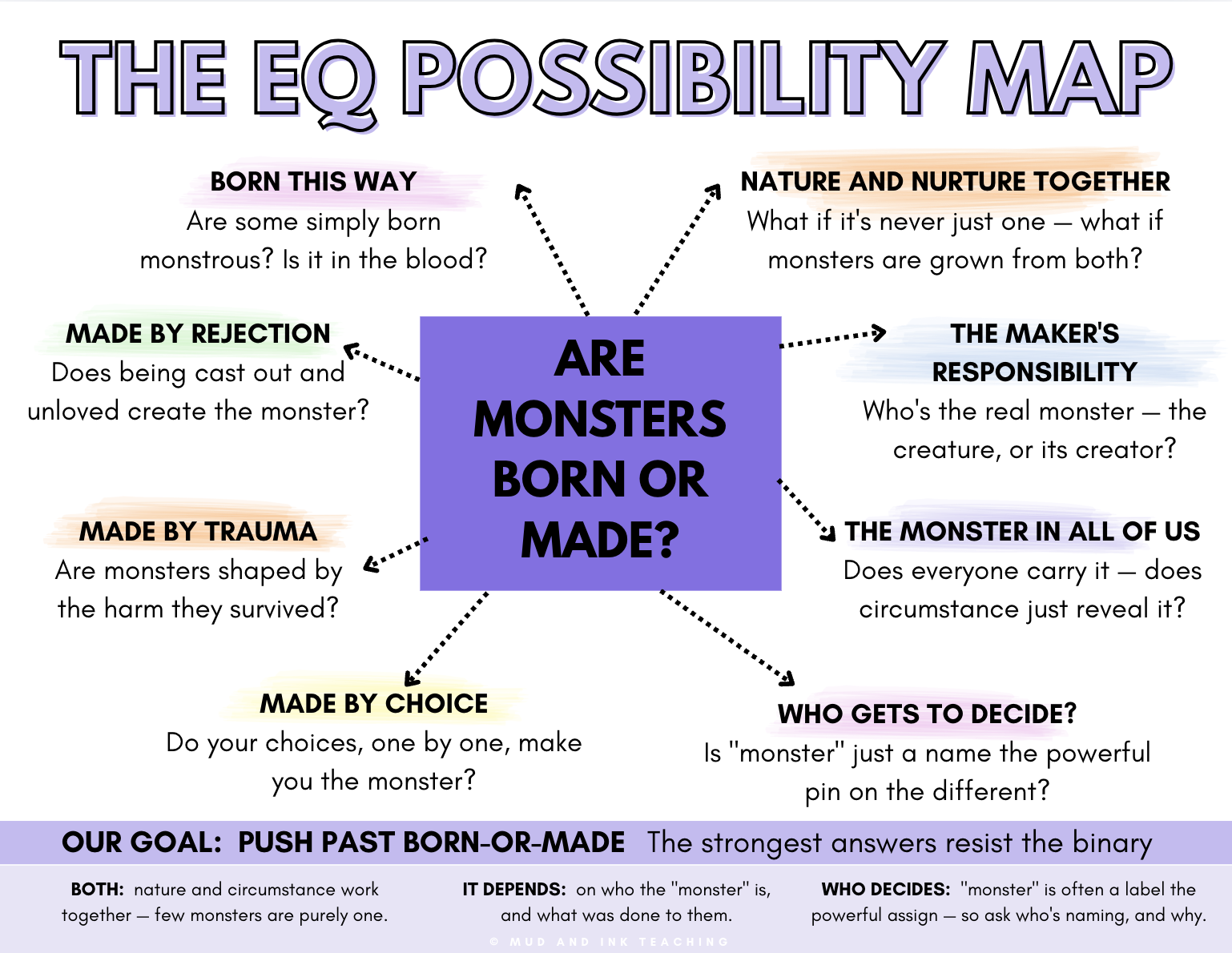
Want the full set of monster pairings on one page? Grab the free EQ Possibility Map — or see the whole approach walked out in Are Monsters Born or Made? The Essential Question That Carries a Whole Monster Unit.
DOWNLOAD YOUR EQ MAP HERE
Close-read the moments that carry the weight
You don't need to close-read all two hundred pages. You need the handful of passages where the argument actually lives.
The creature's own account of himself is the big one. He's eloquent, self-aware, and more honest about loneliness than most of the humans in the book — and when students sit with his words slowly, the "monster" label gets very hard to keep holding. Victor's description of the creation and his flight from it is the other anchor: a maker horrified by his own making. Read those two carefully and your students have everything they need to argue both sides.
(If close reading is the muscle you want to build first, here's how I teach close reading in high school without it floating free of the unit.)
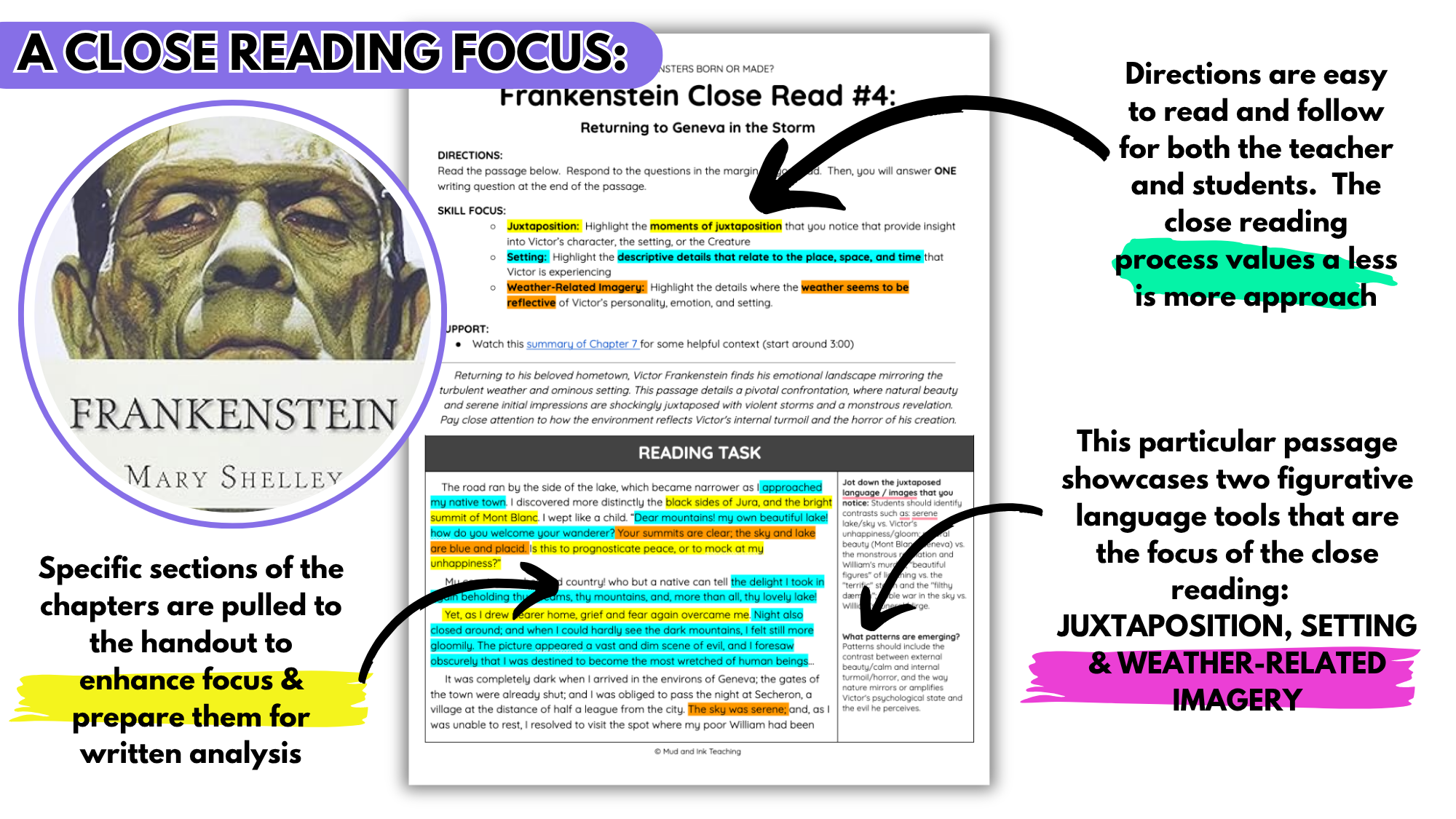
Grab my complete unit with all the close reading passages formatted and ready to assign!
Assess the argument, not the plot
If the unit is an argument, the assessment should be one too. A plot test tells you who kept up with the reading. It tells you almost nothing about whether a student can think.
Two things I'd put at the end instead. A Socratic seminar on the question, where students bring evidence from the novel and the paired texts and have to genuinely listen to one another. And a synthesis essay that asks them to answer are monsters born or made? using everything they read — not a tidy five-paragraph side-pick, but a real position that leaves the grey area in. That kind of writing is exactly what older students need practice in, and a unit built on a question is what finally gives them the room to do it.
If you'd rather not build it from scratch
Everything above is the approach. If you'd rather have it already assembled, that's what these are for:
➡️ My complete Frankenstein inquiry unit is the whole six weeks, built around the novel start to finish: the question-first pacing, the paired supplemental texts, the close-reading passages, the discussion structures, and the synthesis assessment it all builds toward — ready to teach.
➡️ And if you're teaching this question with a different core text — The Odyssey, Greek mythology, Monster — the Are Monsters Born or Made? EQ unit is the same approach without the Frankenstein scaffolding, so it wraps around whatever's already on your syllabus.
Either way, that free map is a perfectly good place to begin.
Keep going
If you want more villains to pull from, start with every villain in your curriculum, sorted by reading realm. For more novels taught this same question-first way, here's how I approach The Great Gatsby and Clarisse in Fahrenheit 451. And because Frankenstein is gothic to its bones, it pairs beautifully with my gothic writing activity and my Masque of the Red Death freebie.
If the inquiry approach itself is the part you want to get stronger at, I teach the whole framework in my free Four Reading Realms webinar.
So tell me — when you teach Frankenstein, who do your students decide is the real monster? I'd love to know whether yours land where mine do.