The week before Thanksgiving break can be treacherous.
Half your roster is already in the car to Grandma's. The other half is physically present and mentally on the couch and happily scrolling. Starting a new unit feels pointless (and is probably a poor planning choice, anyway), a movie day could work but needs to “fit” right where you are, and a packet is just… a packet. (We've all done the packet. No judgment.)
So here's what I want you to try instead. Ask your students one question:
What book would you give your classmates because it powerfully impacted you?
Then give them a class period to actually share those books: face to face, in quick timed rounds, until every kid has given their book away a handful of times and walked out with a list of books their classmates gave them.
That's Booksgiving. And it might be the most meaningful class period of your whole November lesson plan lineup.
What is Booksgiving? (HINT: IT’S Book speed dating with a gratitude twist)
Booksgiving is a book speed dating session built around the gratitude theme of the season — pointed right at the heart of an ELA classroom.
Each student chooses a book that mattered to them (at any point in their lives!) and gives it to classmates in short book talks. Partners trade, record each other's recommendations, and then rotate. By the end of class, every student has a TBR list of peer-recommended books, each one credited to the classmate who gave it!
The best part? You don't need a classroom library. Your students become the library as they bring their whole history of reading to the table.
If you've run a book tasting before, you'll recognize the bones of the lesson. But here's the difference that matters to me the most: in a book tasting, you supply the books and students sample them. In Booksgiving, the books come from the students, they're given person to person, and every recommendation comes straight from students. And we know that a book a friend handed you lands so much differently than one on a teacher list. (Ask any teenager. Or any adult, honestly.)
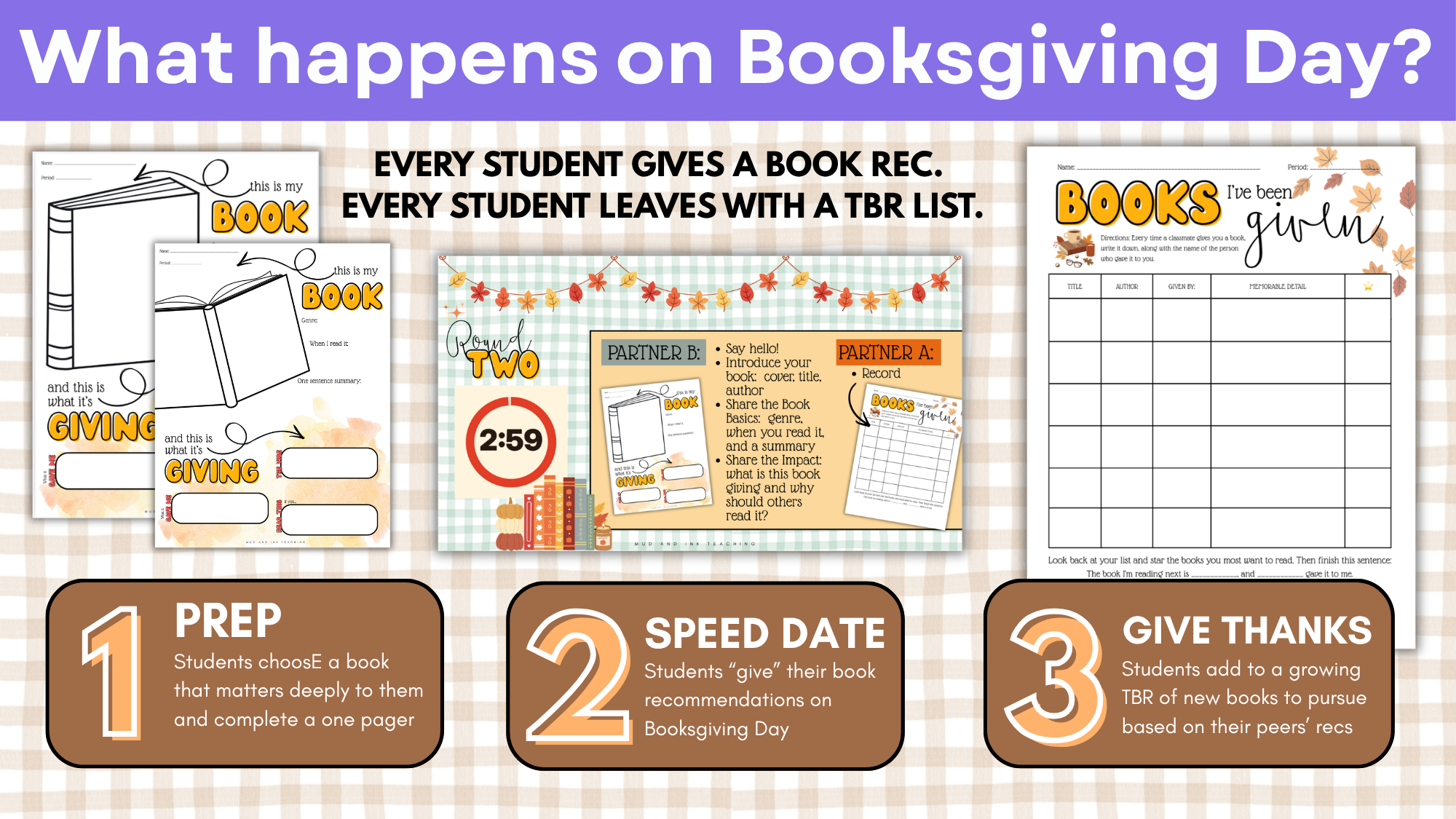
How to host your own Booksgiving in 5 steps
1. Ask the question (a few days ahead)
Pose the framing question: What book would you give your classmates because it powerfully impacted you? Then make the rules generous. Any book from any point in their reading life counts — a novel, a graphic novel, a memoir, a series, a poetry collection, even a picture book from when they were little. It doesn't have to be a school book or a "hard" book. It just has to matter to them.
A few questions help the stuck ones: What book could you not put down? What book made you laugh, cry, or gasp out loud? What book from when you were younger do you still think about?
2. Have students prep a one-pager
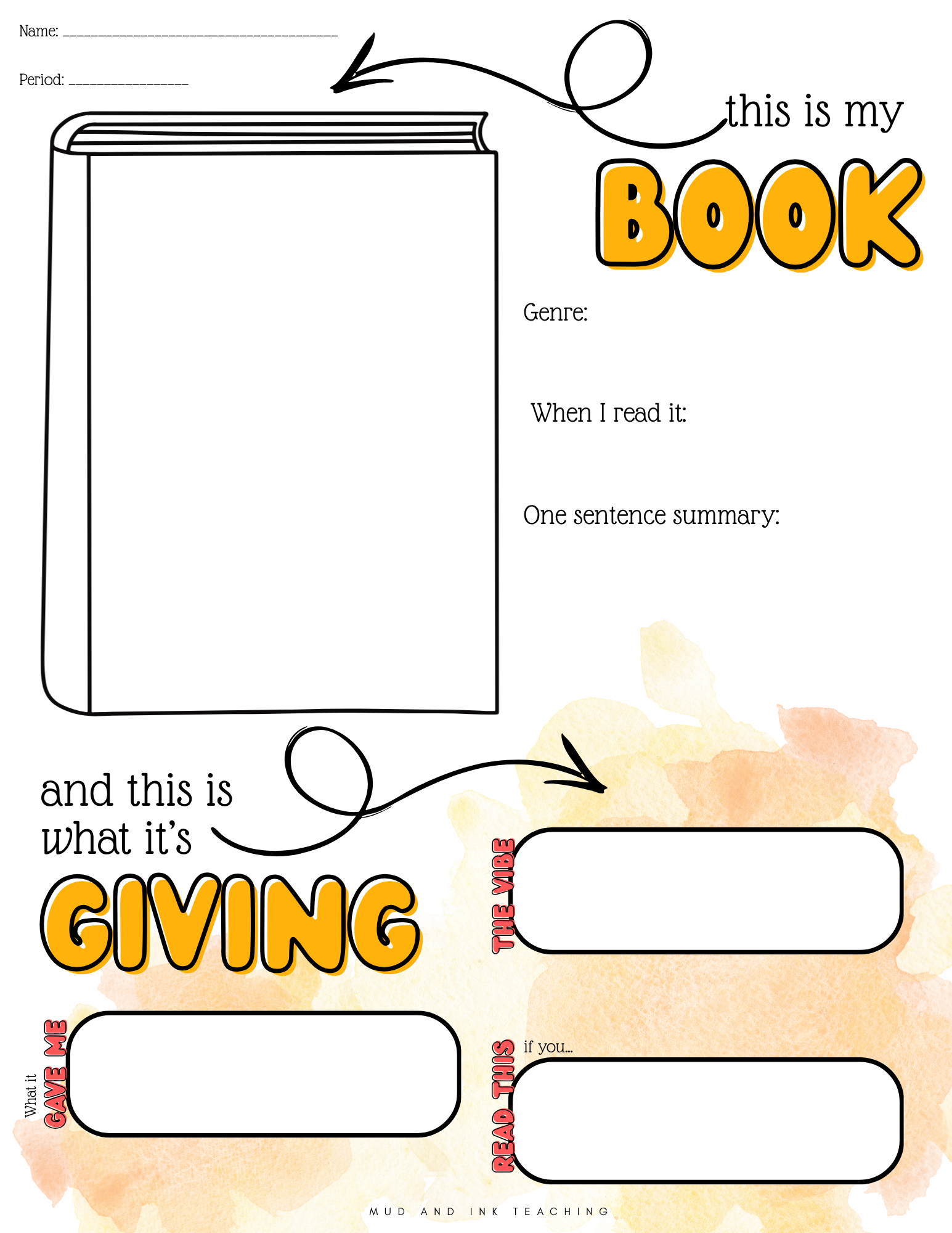
This is what makes the book talks good instead of awkward. Have students build a one-page "book profile" ahead of time — as homework, a bell-ringer over a few days, or part of a class period. On it:
Title, author, and genre (spelled clearly — classmates will copy them down)
When they read it: a grade, an age, a summer, "the year we moved"
A one-sentence, no-spoilers summary. This frame works beautifully: This is about ___ who ___, but ___.
A cover drawing, from memory or redesigned their way
And the part that does more than just plot recap: what the book is "giving." The vibe ("it's giving stayed-up-till-2-a.m."), what it gave them, and who should read it next.
That last piece is where the real thinking happens. Students stop retelling and start talking about why a book mattered — which is the conversation we actually want 🤩.
3. Set up the room
Arrange desks in two rows facing each other (or an inner and outer circle). Partner A stays seated. Partner B moves one seat to the right each round, and whoever's at the end wraps around to the start. Odd number of students? Jump in yourself, or make one trio where two students listen and record.
4. Run the speed-dating rounds
Each round has the same rhythm:
Partner A gives their book, holding up the one-pager and talking (not reading!), while Partner B records it.
Switch. Partner B gives; Partner A records.
Rotate. Partner B moves to the next seat.
Students log every book on a simple collector sheet: title, author, who gave it, and one memorable detail. That "given by" column is the whole heart of Booksgiving, so don't skip it!
I suggest about 3 minutes per person (6 minutes a round) for 6 rounds — roughly 40–45 minutes with transitions. Call each switch and rotation yourself, keep a timer on the board, and then get out of the way and listen. This is meant to be low-stakes, ungraded, and one more meaningful way to spend time together building a reading culture that’s not grounded in points (don’t even tempt yourself with participation points!). If you want to grade the one pager, fine. But let the conversation flow naturally.
5. Close with gratitude
Have students look back over everything they were given, star the books they most want to read, and finish one sentence:
"The book I'm reading next is ___, and ___ gave it to me."
If you have a few minutes, go around and let every student say theirs out loud. Watching students react when they hear their names and their books is priceless. That's the moment I look forward to most!
"But what about the kid who says they don't have a book?"
You know the one. (You might have six of the one.)
Here's the fix: students who can't name a book that mattered to them give a book they want to read instead, and share what caught their eye. Send them to the library, a few curated booklists, or my Amazon storefront to find one. Nobody sits out, and "I want to read this because…" is still a real recommendation.
Make it fit your (very unpredictable) week
The week before break is chaos, so Booksgiving bends:
Short on time? Run 3–4 rounds. That still gives every student a solid list.
Split it across two days. Three rounds a day, and use the rest of the period for 1:1 conferencing, makeup testing, or independent reading.
Teaching a 90-minute block? Run all six rounds, then extend: post the one-pagers as a "gallery of givers" for students to sticky-note, do a whole-class share, or have students write a quick thank-you note to the classmate whose book they starred first.
After Booksgiving: keep the reading going
Don't let those lists disappear into a backpack. Post the one-pagers on a bulletin board or hallway wall as an instant peer-recommended reading list. Keep the collectors in reading folders — they're gold for reading conferences ("So, Maya gave you this one. Have you started it?").
And if you want students tracking the books they were given all the way through winter break and beyond, my Independent Reading Journal 12-Month Bundle picks up right where Booksgiving leaves off.
Skip the prep: the Booksgiving kit
Everything above, you can absolutely build yourself. But if your November looks anything like mine, you might rather spend that time on literally anything else.
So I made the whole thing for you. The complete Booksgiving kit is $6 and includes:
An editable slide deck that runs all six rounds for you — Partner A, Switch, Partner B — with built-in 3-minute timers you can change, cut, or swap for your favorite YouTube timer
A student directions page that walks kids through choosing a book and prepping their book talk
The "This is my BOOK" one-pager in six cover styles, with the "what it's GIVING" prompts built in
The "Books I've Been Given" collector and TBR sheet, with the closing sentence at the bottom
A teacher guide with setup, room rotation, timing for any schedule, and extension ideas
Print-ready PDF plus editable Canva templates
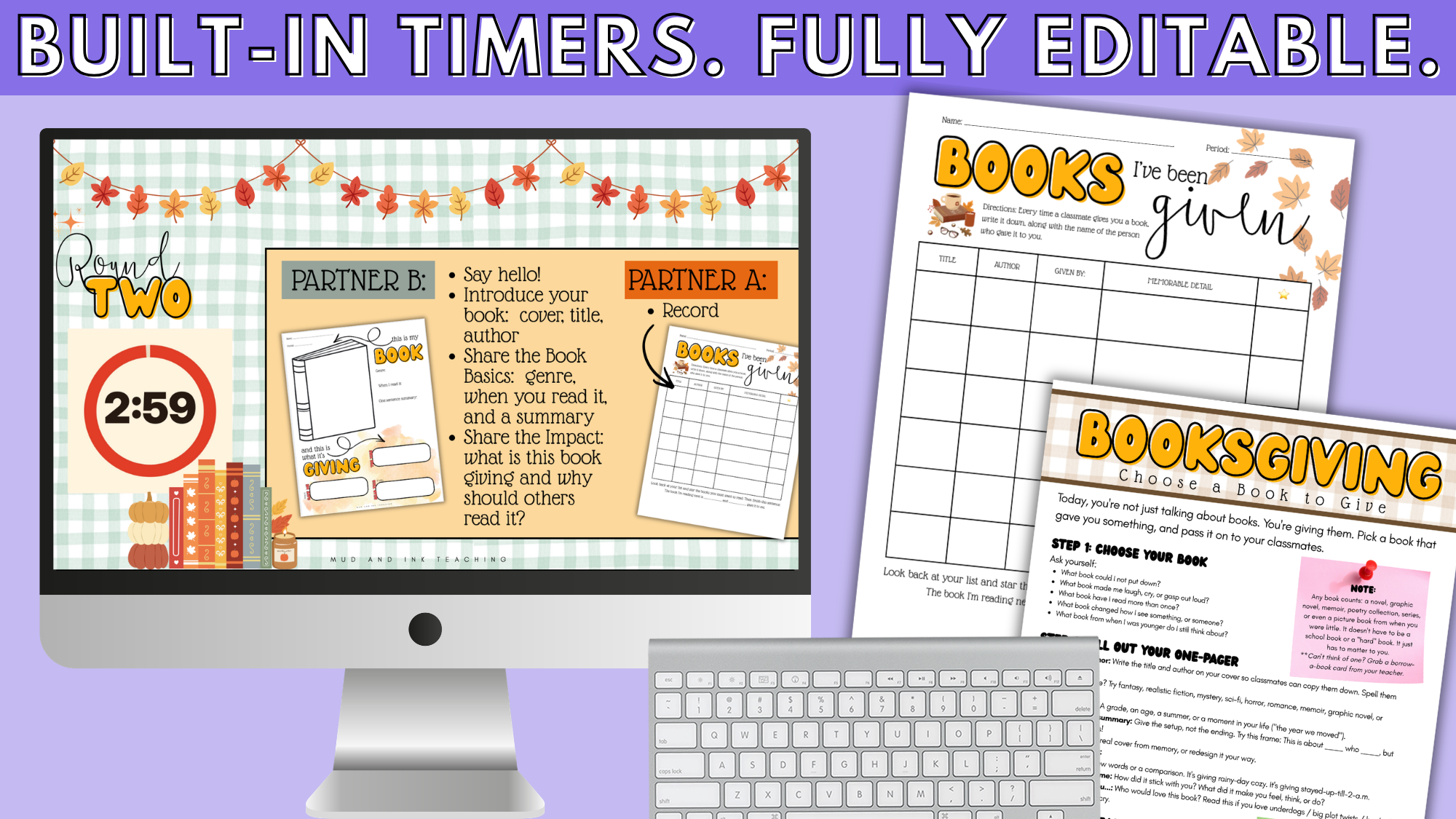
Print it, assign the one-pager, and you're ready for the week before break.
One last thing
I keep coming back to that closing line — the book I'm reading next is ___, and ___ gave it to me. There's something about a teenager writing a classmate's name next to a book that a reading log can't touch.
So tell me: what book would you give? Drop it in the comments. I'm always adding to my list.