Are Monsters Born or Made? The Essential Question That Carries a Whole Monster Unit
Here's the temptation, and I feel it every single time I teach argument: we hand students a question, tell them to pick a side, and send them off to find evidence to defend it. Born or made. Choose one, prove it, and turn it into an essay.
And honestly? That's not wrong — at first. When we're first teaching kids to argue, picking a side is the work. You can't learn to hold a line until you've learned how to take one. That's a developmental starting point, and it's a good one.
But our older students need something more, and we don't always give it to them. Somewhere in the secondary years, students have to learn that the most honest answer to a real question usually isn't born or made — it's both, or it depends, or wait, who decided this was a monster in the first place? That grey area between the two sides is where mature thinking lives (and it’s the kind of thinking our future world needs so desperately!).
Our mistake is not ignoring this truth, but only making space for it in the once-in-a-while assessment. We can’t simply drop a teenager into it once, at the end of a unit, in a formal essay, and expect them to be fluent in negotiating the grey area of complex questions. They have to live there — repeatedly, low-stakes, out loud.
That's what an essential question is for. It's not just a prettier way to frame a unit through inquiry — though it does that too. It's the stepping stone that gives students both permission and practice in the in-between. And here's the part I care about most: when one question carries an entire unit instead of showing up once on an essay prompt, you get hundreds of small, almost casual chances to push into that grey space. A bell-ringer. A two-minute aside. A "wait — does that change your answer?" dropped into the middle of a Tuesday. That's how kids actually get good at nuance — not formally, once, but constantly, together.
"Are monsters born or made?" is one of the best questions I know for this. So let me show you how I teach it — not as a debate with two answers, but as a doorway your students can argue through for weeks. (And at the end, there's a free one-page map of the whole thing, plus the done-for-you unit if you'd rather not build it from scratch.)
The grey area is the whole point
Once you stop treating "born or made" as a yes/no, three richer answers show up — and these are exactly the moves you want your older students reaching for:
Both. Nature and circumstance almost always work together. Hardly any monster is purely one thing.
It depends. On who the "monster" actually is — and on what was done to them first.
Who decided? This is the one that cracks the whole unit open. "Monster" is often just a label — a name the powerful pin on the different or the inconvenient. So ask your students: who's doing the naming here, and what do they get out of it?
Not one of those fits on a pick-a-side essay line — which is exactly why they're worth teaching. That last move alone turns a literature unit into a real-world critical-thinking conversation. But here's the catch: you cannot get there with one text.
Why one novel can't do it (and what actually can)
Most monster units hang everything on a single book — usually Frankenstein. And Frankenstein is wonderful. But one text can only ever give your students one version of this story. One monster, one angle, one answer they can shrug at.

Be sure you’re following me on Instagram to catch the video tutorial of this series!
The thing that makes the question come alive isn't the core text. It's the supplemental texts — and I mean that structurally, not as a nice-to-have. Your supplementals aren't the extra credit of the unit. They're the engine. The moment you set a second monster beside your novel, the two of them start arguing with each other, and your students are the ones who get to referee.
One text is a verdict. Two texts in conversation are an argument. And an argument is what runs a unit for three weeks without going stale.
Let me show you what I mean.
(One honest note first: a few of these deal with real, heavy things — sexual assault, racism, violence done to kids. They're absolutely worth teaching, and teenagers rise to them when we set them up with care. But you know your room better than I do, so preview anything you're putting in front of a whole class.)
Medusa — "who gets to decide?"
Everyone knows Medusa: snakes for hair, a face that turns you to stone, the monster on the Greek vase. Almost nobody knows she was a mortal woman and a priestess, assaulted by Poseidon in Athena's own temple — and then punished for it, by Athena, with the snakes and the curse and the exile. The hero who finally kills her, Perseus, needs a borrowed shield and a bag of magic items to do it, and she never once attacks him. That's the version we don't teach.
Put Medusa next to your novel's monster and watch what happens: the question stops being is this character evil? and becomes who decided she was the monster, and what did they get out of saying so? Your students can't un-ask that about the creature once they've asked it about her.
2. The Phantom — "made by rejection"
The Phantom of the Opera was put in a cage as a child so strangers could pay to look at his face. Then he grew up, escaped — and built himself a cage in a basement to live in. Nobody made him do that second part. He's the monster your students will split on, because both readings genuinely hold: the world caged him, and he kept himself there. A single text hands kids one answer. This pairing hands them a fight worth having.
3. The makers of Jurassic Park — "the maker's responsibility"
Here's the one that flips the whole question. Nobody watching Jurassic Park thinks the people are the villains — everybody blames the dinosaurs. But every expert in that film says don't, and the people with the money overrule them, and the animals only ever do exactly what they were built to do. Set that beside Victor Frankenstein and suddenly your unit isn't asking who the monster is. It's asking who made one and walked away. That's what a well-chosen supplement does — it doesn't just add a text, it changes what your core text is even about.
The map:
eight ways into one question
Medusa, the Phantom, and the makers are three angles. There are eight. I mapped all of them onto a single page — the eight different forces that can create or reveal a monster, each with its own sub-question and a set of texts that fit it — so you can see the whole terrain at a glance and pick the angle that matches whatever you're already teaching.
It works as a planning tool for you and as an anchor chart for your wall, and your students can use it to figure out which "way in" their chosen monster belongs to.
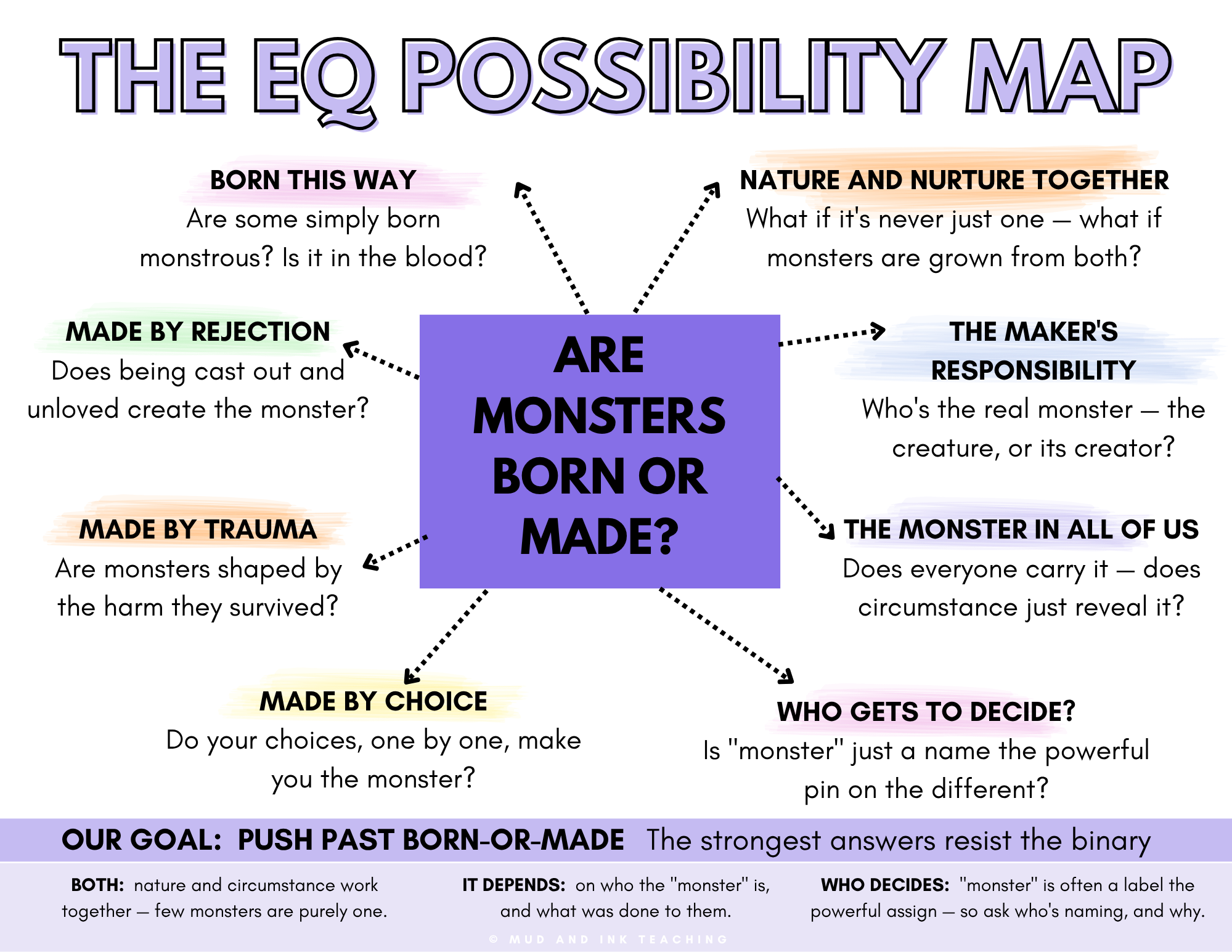
I’d love to send you the PDF version of this for you to use in your lesson planning!
Grab the free EQ Possibility Map here
What you get on the other side
When you teach the question this way — one core text, several supplementals, all in conversation — here's what actually happens in the classroom:
A Socratic seminar where nobody's faking or performing because they've got six texts to pull from instead of one (everyone can find an entry point that they care about).
An argument essay where students actually have a position worth defending, because the evidence genuinely points both ways.
And a unit that holds for weeks without getting boring, because the question never resolves into a tidy answer.
And underneath the big moments, the biggest win of all: all those low-stakes reps in the grey area. Every supplemental is one more casual chance for students to wrestle with the in-between — so by the time the formal essay arrives, living between born and made isn't a leap, it's a habit.
That's rigor, not fluff. And notice what you didn't have to do: you didn't have to entertain anybody. You just chose the right things to put next to each other.
Want it already built?
You can absolutely build this yourself — pull the supplementals, write the trackers, design the seminar, make the assessment. I did exactly that for years.
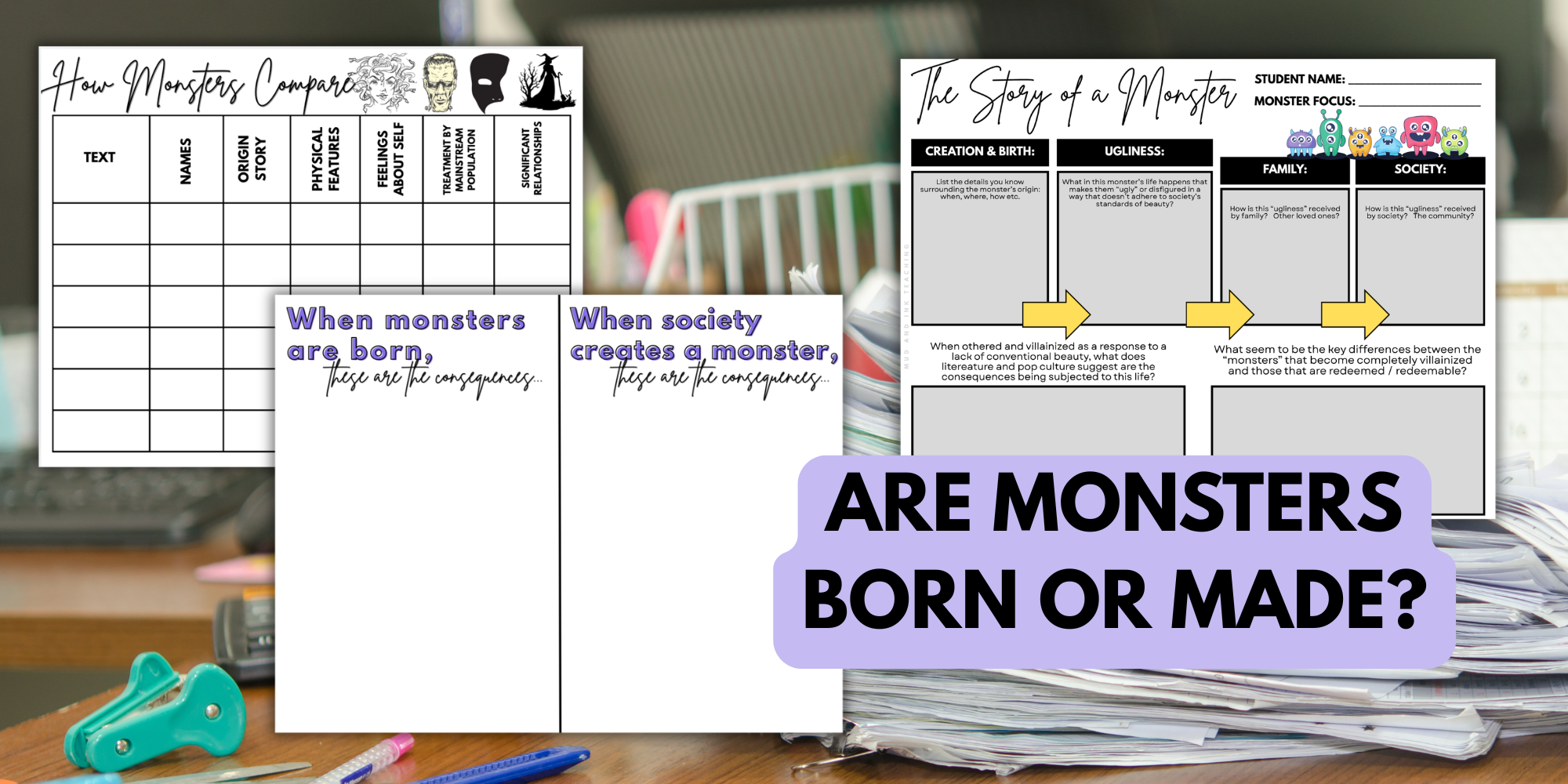
Or, if you'd rather not spend your October building five supplemental lessons from scratch, I've already done it for you. My Are Monsters Born or Made? EQ Inquiry Unit is the done-for-you version of everything above: five ready-to-teach supplementals (Medusa, the Phantom, Wicked, a nature-vs-nurture crash course, and the "superpredator" media-myth lesson), evidence trackers, discussion and jigsaw templates, two pacing calendars, and a synthesis assessment. Set the novel aside, center the question, and let the texts do the work. It's built to wrap around whatever you're already teaching — teachers have run it with The Odyssey, Greek mythology, Monster, and yes, Frankenstein.
Teaching Frankenstein specifically? The complete 6-week Frankenstein inquiry unit folds this whole EQ approach around the novel, start to finish.
Keep going
If you want more villains to choose from, start with every villain in your curriculum, sorted by reading realm — it's the easiest way to find the monster that fits the unit you're already running. For the close-reading muscle underneath all of this, here's my secondary close reading framework, and if you want to see a single villain read all the way down, I did it with Iago. Teaching this in October? Pair it with my Halloween and fall lessons for secondary ELA.
And if the inquiry approach itself is the part you want to get better at, I teach the whole framework in my free Four Reading Realms webinar — that's the real front door to everything I do.
So tell me — which monster would your students argue hardest about? Drop it in the comments. It might just become the next one I write up.